You Won’t Believe Paris Has *This* Kind of Terrain — I Was Totally Unprepared
When you think of Paris, smooth boulevards and elegant stone buildings come to mind—not rugged trails or hidden hills. But beneath its polished surface, Paris surprises with unexpected terrain: secret slopes, sunken gardens, and elevated pathways that feel worlds away from the tourist crowds. I stumbled on these layers by accident, and they completely changed how I experienced the city. This isn’t just a skyline of spires and cafes—it’s a quietly wild urban landscape waiting to be explored on foot, one surprising step at a time.
The Myth of Flat Paris: Breaking the Stereotype
Most travelers picture Paris as a graceful, level city—neatly arranged along the Seine, with wide avenues radiating from grand monuments. This image isn’t wrong, but it’s incomplete. In truth, Paris is a city of subtle elevations, quiet climbs, and tucked-away inclines that defy its reputation for flat elegance. While not mountainous, the city’s topography is far from uniform. Across its twenty arrondissements, small but meaningful changes in elevation shape neighborhoods, influence architecture, and alter the rhythm of daily life. These variations are not dramatic in the way alpine landscapes are, but they are present, purposeful, and deeply woven into the urban fabric.
The perception of flatness persists because many of Paris’s most famous sites—like the Champs-Élysées, the Louvre, and Notre-Dame—are located in low-lying areas. These landmarks dominate postcards and guidebooks, reinforcing the idea that Paris unfolds on a single horizontal plane. Yet, just a short walk from these centers, the ground begins to rise. Areas like Montmartre in the 18th arrondissement and Belleville in the 20th stand out as natural high points, their hills formed by ancient geological shifts. These elevated zones were once outside the city limits, perched on limestone buttes that resisted erosion while surrounding land wore down over millennia.
Walking through these districts reveals a different Paris—one where breath comes slightly harder, where delivery bikes pause mid-pedal, and where staircases weave between buildings like hidden threads. The incline isn’t just a physical challenge; it creates a psychological shift. As you climb, the city unfolds below in layers: rooftops tilt, streets converge, and the hum of traffic softens. This change in elevation alters perspective, both literally and emotionally. It slows movement, encourages pauses, and fosters intimacy with the surroundings. The city feels more alive, more textured, when you experience it not just visually, but kinesthetically.
Understanding this hidden dimension of Paris adds depth to any visit. It transforms a sightseeing tour into a sensory journey. The hills of Montmartre and Belleville are not anomalies; they are integral to the city’s character. They shaped settlement patterns, influenced transportation routes, and contributed to the distinct identities of their neighborhoods. Recognizing these subtle shifts in terrain allows travelers to move beyond the postcard and engage with Paris as a living, breathing place—shaped by time, geology, and human adaptation.
Montmartre’s Hidden Slopes: More Than Just a Hill with a View
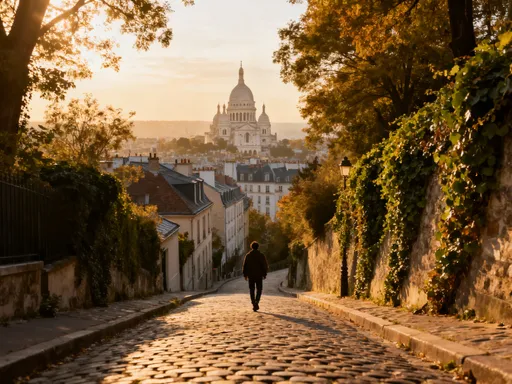
Montmartre is perhaps the most famous elevated district in Paris, known worldwide for the gleaming dome of Sacré-Cœur and its artistic legacy. Yet many visitors ascend only the main path from Place du Tertre, missing the intricate network of side streets, staircases, and back alleys that define the true character of the hill. The climb itself is part of the experience—one that unfolds gradually, revealing quiet courtyards, ivy-draped facades, and sudden vistas over the city. Unlike the tourist-packed summit, the lower slopes of Montmartre offer a more grounded, human-scale encounter with Parisian life.
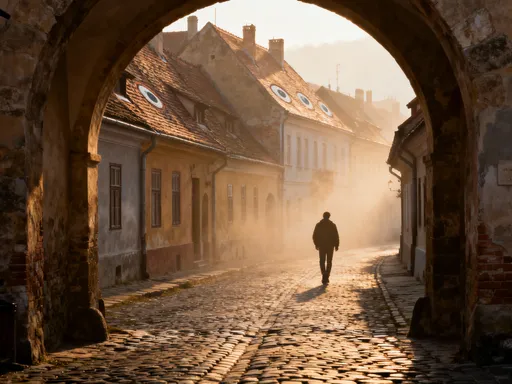
Begin at the foot of Rue Lepic, a winding street that rises steadily from the edge of the 9th arrondissement. Here, the incline is gentle at first, but soon becomes more pronounced. The cobbled surface, uneven and worn smooth in patches, demands attention with every step. Local bakers wheel carts uphill, their muscles taut with effort. Delivery riders on electric bikes lean forward, gripping handlebars as motors whir in protest. Even pedestrians adjust their gait, planting feet firmly with each upward stride. This is not a city built for ease—it rewards endurance.
The sensory details accumulate: the faint metallic creak of the old tram line that runs parallel to the street, the scent of fresh bread mingling with damp stone, the way sunlight filters through laundry lines strung between buildings. Vines climb ancient walls, their leaves rustling in the breeze. Small shops line the route—cheese counters, flower stalls, and family-run cafes where regulars greet each other by name. These are not curated experiences for tourists; they are the rhythms of daily existence, shaped by the hill’s persistent slope.
Reaching the top near Sacré-Cœur feels earned, not given. The panoramic view—stretching from the Eiffel Tower to the distant suburbs—is all the more powerful because it was achieved through effort. This sense of reward is central to Montmartre’s appeal. Unlike cities where landmarks are easily accessible by metro or car, here, the journey is inseparable from the destination. The climb teaches patience, presence, and appreciation. It reminds visitors that beauty is not always immediate; sometimes, it must be climbed for, step by step, breath by breath.
The Butte Bergeyre: A Forgotten Rise with a Local Soul
Just a few kilometers northeast of Montmartre lies a lesser-known elevation that feels like a secret: the Butte Bergeyre. Tucked between the 18th and 19th arrondissements, this small hill is easy to miss, hidden behind apartment blocks and railway lines. Yet within its narrow boundaries lies a village-like enclave, a quiet world of winding staircases, sloped footpaths, and tightly packed houses with flower-filled balconies. Unlike the tourist-heavy peaks of Montmartre, Butte Bergeyre remains a place of local life, where children play on steps, neighbors chat over garden fences, and the pace of movement is slow and deliberate.
Accessing the butte requires intention. There are no signs pointing the way, no guided tours. Visitors must navigate through residential streets, then ascend a series of stone staircases that rise between buildings like hidden passages. Each turn reveals a new perspective: a sunlit courtyard, a mural painted on a gable end, a small garden tended by residents. The terrain is uneven, the paths narrow and sometimes slippery after rain. But this modest challenge is part of the charm. The effort of the climb creates a sense of arrival, of stepping into a different world—one that feels protected, almost timeless.
The community here has preserved its character against the pressures of urban development. In the 1920s, residents famously resisted city plans to demolish their homes, organizing protests and petitions to save the neighborhood. Their success is evident today in the intact architecture and strong sense of ownership. Hand-painted signs welcome visitors, and flower boxes bloom in season. The hill’s elevation, though slight, contributes to its seclusion. From the top, one can see rooftops stretching toward Gare du Nord, yet the noise of the city feels distant, muffled by the hill’s gentle rise and the dense vegetation.
Butte Bergeyre offers a rare glimpse into Paris as a collection of intimate neighborhoods rather than a single grand monument. It demonstrates how terrain can foster community, encouraging interaction among residents who share the same slopes and stairways. For visitors willing to explore beyond the map, it is a reminder that the most meaningful experiences in Paris are often found off the beaten path—where the ground rises quietly, and the city reveals its softer, more personal side.
Parc des Buttes-Chaumont: Where Nature Meets Dramatic Elevation
Among Paris’s many green spaces, few match the Parc des Buttes-Chaumont for topographical drama. Located in the 19th arrondissement, this 25-hectare park was created in the mid-19th century on the site of a former gypsum quarry and landfill. What could have been a flat, reclaimed space instead became a masterpiece of engineered landscape, complete with cliffs, waterfalls, a suspended temple, and winding paths that plunge and rise with theatrical flair. The park is a testament to how human design can amplify natural terrain, creating an environment that feels both wild and carefully composed.
Entering from the south, visitors descend a steep path into a sunken valley, where a lake reflects the surrounding rock faces. The change in elevation is immediate and striking. One moment you are at street level; the next, you are surrounded by towering limestone cliffs, their surfaces pockmarked and weathered. A suspension bridge arcs across the water, leading to the Temple de la Sybille, a small rotunda perched on a rocky islet. The climb to reach it is deliberate, requiring effort and attention to footing. This is not passive scenery—it demands engagement.
From the temple, the path continues upward through a series of switchbacks, climbing the northern slope of the park. The incline is steady, offering alternating views of the lake below and the city beyond. Joggers pass by, their breath steady with exertion. Families picnic on grassy terraces, their blankets spread across gentle slopes. Children fly kites near the summit, where the wind moves freely across open lawns. Every element of the park’s design takes advantage of its varied elevation, turning what was once industrial wasteland into a dynamic space for recreation and reflection.
The Buttes-Chaumont is also a place where Parisians interact with nature on their own terms. Unlike the formal gardens of the Luxembourg or Tuileries, this park feels untamed, even if every cliff and curve was planned. The terrain encourages movement—up, down, around. It invites exploration, rewarding those who wander with unexpected vistas and moments of solitude. In spring, cherry blossoms line the slopes; in autumn, the leaves turn gold and rust, carpeting the paths in soft color. The park’s elevation changes make each season feel distinct, each visit a new experience.
The Seine’s Embankments: Flowing Paths with Subtle Gradients
While the hills of Paris offer vertical drama, the banks of the Seine provide a different kind of terrain—one defined by gentle slopes, rhythmic gradients, and the constant presence of moving water. The quays that line the river are not perfectly level; they rise and fall slightly with the contours of the riverbank, creating a subtle but perceptible change in elevation as one walks east to west. These ribbons of land, paved and planted, form one of the city’s longest continuous walking routes, stretching over 8 kilometers through the heart of Paris.
Walking along the Rive Gauche or Rive Droite, especially in the early morning or late evening, one becomes attuned to these small shifts. A slight incline leads to a footbridge; a descent brings you closer to the water’s edge, where houseboats rock gently against the current. Some access points are marked by wide staircases that drop down to floating gardens or riverside cafes. These transitions—between street level and river level—add dimension to the journey. They break the monotony of flat walking, introducing variety into even the simplest stroll.
The rhythm of the embankments is meditative. The sound of water, the glide of passing boats, the reflection of bridges and buildings—all contribute to a sense of flow. But so does the terrain. The slight gradients encourage a natural pace, neither too fast nor too slow. They invite pauses on benches, moments of looking down at the water or up at the skyline. For many Parisians, these paths are part of daily life—routes to work, places for exercise, spots for quiet contemplation. The subtle elevation changes make the walk more engaging, more physically present.
In recent years, the city has enhanced these spaces with green zones, outdoor reading areas, and pop-up beaches in summer. These additions respond to the unique character of the embankments, recognizing that their value lies not just in views, but in the experience of moving along them. The terrain, though modest, supports a rich variety of activities. It connects neighborhoods, links landmarks, and offers a continuous thread through the urban landscape—one that rises and falls with the river’s quiet pulse.
Rooftop Walks and Elevated Passages: Paris from Above Ground Level
Paris’s terrain is not limited to natural hills and riverbanks. The city also offers a network of man-made elevated spaces—roof terraces, covered passages, and sky bridges—that provide alternative perspectives on its topography. These structures lift the walker above street level, offering panoramic views and a sense of detachment from the bustle below. While not as physically demanding as climbing a hill, they contribute to a layered understanding of the city’s verticality.
One notable example is the elevated walkway near the Forum des Halles, a modern complex in the 1st arrondissement. From its upper levels, visitors can see the surrounding rooftops stretching in all directions, a sea of zinc and slate punctuated by church spires and the occasional garden. The walkway connects buildings, allowing movement above the crowds. It is both functional and aesthetic—a space designed for transit that also invites lingering. Similarly, the garden terrace of the Musée du Quai Branly, perched above the Seine, offers a lush, elevated path lined with trees and indigenous plants. From here, the Eiffel Tower rises just across the water, framed by foliage and open sky.
These spaces demonstrate how architecture can extend the concept of terrain beyond natural landforms. They create new vantage points, new ways of moving through the city. They also reflect a growing emphasis on pedestrian-friendly design, where walking is not just a means of transport but a form of discovery. By rising above the street, visitors gain a broader view of Paris’s layout—its arrondissements radiating outward, its green spaces dotting the urban grid, its rivers winding like veins.
The experience of height, even when achieved through stairs or escalators, alters perception. It allows one to see patterns—how streets align, how parks are positioned, how light falls across rooftops at different times of day. It complements the ground-level exploration of hills and quays, adding a third dimension to the journey. Together, these elevated passages enrich the walker’s understanding of Paris as a city built not just on a map, but in space, with depth, height, and shadow.
Why Terrain Matters: Re-Seeing the City Through Your Feet
Understanding Paris’s terrain is not merely a matter of navigation; it is a way of deepening connection to the city. When travelers move beyond the icons and begin to feel the ground beneath their feet—the incline of a street, the step of a staircase, the slope of a park—they engage with Paris on a more intimate level. The body becomes a tool of discovery, registering changes that the eyes might miss. This physical awareness fosters a richer, more immersive experience, one that lingers long after the trip ends.
The city’s topography is intertwined with its history. Hills like Montmartre and Butte Bergeyre were once outside the city walls, home to windmills, quarries, and vineyards. Their elevation made them strategic points, later shaping the development of neighborhoods and transportation routes. The Seine’s banks, once lined with docks and warehouses, have been transformed into public spaces that follow the river’s natural gradient. Even the engineered drama of the Buttes-Chaumont reflects 19th-century ideals of landscape design, where nature was sculpted to inspire awe and reflection.
For visitors, embracing this physical dimension means choosing the right shoes—supportive, broken-in, with good grip. It means walking in the early hours when the city is quiet and the air is cool. It means carrying a simple topographic map or using a mobile app that shows elevation changes. These small preparations enhance comfort and safety, allowing for longer, more enjoyable exploration. But more than that, they signal an intention—to see Paris not just as a collection of sights, but as a living landscape shaped by time and human effort.
Ultimately, terrain invites a slower, more mindful way of traveling. It encourages pauses, rewards curiosity, and reveals hidden corners of the city. It reminds us that Paris is not a static image, but a dynamic place where geology, history, and daily life intersect. To walk its slopes and stairways is to participate in that story—to feel, in every step, the quiet resilience of a city that has risen, again and again, from its own uneven ground.
Paris is not just a postcard of landmarks—it’s a city shaped by quiet rises, sunken paths, and layered landscapes that reward slow, intentional exploration. By tuning into its special terrain, you don’t just see Paris differently—you feel it in your muscles, your breath, your stride. The real magic isn’t only in what you look at, but in how the ground beneath you tells the story of centuries, community, and quiet resilience. Step off the flat paths. Let the city rise and fall beneath your feet—you’ll never walk it the same way again.